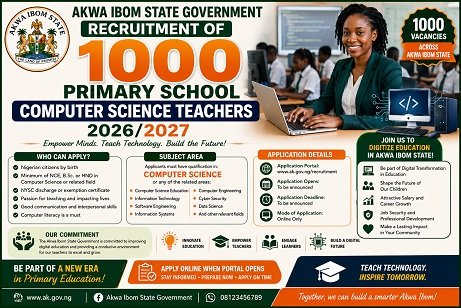
Akwa Ibom State Government Recruitment of 1000 Primary School Computer Science Teachers 2026/2027
The proposed recruitment of 1000 Primary School Computer Science Teachers in Akwa Ibom State for the 2026/2027 academic cycle represents a strategic shift toward digital education reform at the foundational level. As Nigeria deepens its focus on STEM education, coding literacy, and digital skills acquisition, state governments are increasingly integrating computer science into primary school curricula.
This guide provides a comprehensive, research-based breakdown of what applicants should expect, how to prepare, projected salary structures, eligibility criteria, and strategic application advice. All projections are clearly identified where official announcements are pending.
Why Akwa Ibom State Is Recruiting Computer Science Teachers
Over the past decade, educational policy across Nigeria has gradually incorporated ICT into basic education. Several factors are driving this expansion:
- National digital economy policy implementation
- Increased demand for early tech exposure
- Universal Basic Education curriculum reform
- Rising need for digital literacy in rural communities
- Preparation for global competitiveness
Primary education is the most critical stage for foundational skill development. Introducing structured computer science instruction at this level helps pupils:
• Develop logical reasoning
• Understand digital tools
• Learn basic coding principles
• Improve problem-solving skills
• Adapt to emerging technologies
Akwa Ibom State has historically invested in education infrastructure, and the recruitment of specialized computer science teachers aligns with broader modernization efforts.
Is the Recruitment Officially Announced?
As of the time of writing, applicants are advised to monitor official state government channels for confirmation. Recruitment information should only be verified through:
• Akwa Ibom State Government official website: https://employment.akwaibomstate.gov.ng/register
• State Universal Basic Education Board (SUBEB) announcements
• Ministry of Education publications
• National and reputable newspapers
Applicants must avoid social media rumors and unofficial agents.
Objectives of Recruiting 1000 Computer Science Teachers
The government’s potential objectives may include:
- Strengthening ICT education in public primary schools
- Reducing pupil-to-teacher ratio in digital subjects
- Introducing structured computer labs in rural schools
- Standardizing digital curriculum implementation
- Supporting long-term digital transformation agenda
This recruitment would significantly increase access to digital literacy across the 31 Local Government Areas in the state.
Akwa Ibom State Government Recruitment of 1000 Primary School Computer Science Teachers 2026/2027
Who Can Apply? Expected Eligibility Criteria
While final criteria will depend on official release, applicants should anticipate the following minimum requirements:
Academic Qualifications
- NCE in Computer Science
- NCE in Computer/Integrated Science
- B.Ed in Computer Science
- B.Sc in Computer Science with PGDE
- B.Tech in Computer Science with PGDE
Additional certifications may be advantageous:
• Microsoft certifications
• Cisco certifications
• Google educator certifications
• ICT teaching experience
NYSC Requirement
• NYSC discharge certificate
• NYSC exemption certificate (where applicable)
Age Requirement
Projected age range:
• 22 to 35 years (may vary based on policy)
Citizenship Requirement
Preference may be given to:
• Indigenes of Akwa Ibom State
• Residents with valid proof of domicile
Core Competencies Expected from Applicants
Applicants must demonstrate practical knowledge in:
- Basic programming concepts
- Introduction to coding for children
- Computer hardware fundamentals
- Microsoft Office proficiency
- Internet safety education
- Classroom ICT integration
Primary school teaching requires simplified instruction delivery. Applicants should understand how to:
• Teach complex concepts in simple language
• Use visual learning tools
• Incorporate interactive methods
• Manage young learners effectively
Projected Application Process for 2026/2027
Based on previous state recruitments, the likely process may include:
Step 1: Online Registration
Applicants will:
- Create an account on official recruitment portal
- Fill biodata form
- Upload scanned credentials
- Submit application
Step 2: Shortlisting
Shortlisted candidates may be invited for:
• CBT examination
• Aptitude test
Step 3: Computer-Based Test (CBT)
Expected areas include:
- General knowledge
- English language
- Mathematics
- Basic computer science
- Teaching methodology
Step 4: Oral Interview
Candidates may:
• Deliver a mini teaching demonstration
• Answer technical computer science questions
• Explain child-centered teaching strategies
Step 5: Document Verification
Original documents will be verified physically.
Step 6: Final Appointment
Successful candidates receive:
• Appointment letter
• Posting information
• Probation guidelines
Computer Science Topics Likely to Be Tested
Applicants should revise:
- What is an algorithm?
- Flowcharts and logic design
- Basic Scratch programming
- Microsoft Word, Excel, PowerPoint
- Internet safety principles
- Computer components and functions
- Types of software
- Digital citizenship
Because this is primary school level, emphasis may be on simplified concepts rather than advanced coding.
Skills That Increase Selection Chances
To stand out in competitive recruitment:
- Classroom teaching experience
- Ability to create digital lesson plans
- Knowledge of child psychology
- Basic troubleshooting skills
- Communication and presentation skills
- Evidence of ICT workshops attendance
Recruitment panels often prioritize competence and classroom adaptability.
Importance of Computer Science in Primary Schools
Introducing computer science early improves:
- Analytical thinking
- Creativity
- Innovation mindset
- Digital awareness
- Confidence in technology usage
Children who start digital education early adapt faster to:
• Secondary school STEM subjects
• Robotics
• Coding competitions
• Digital entrepreneurship
Projected Salary Structure (Estimated 2026)
Although official figures must be confirmed through government publication, projected estimates based on public service salary scales are as follows:
NCE Holders – Grade Level 07
• ₦80,000 – ₦100,000 monthly
• Annual estimate: ₦800,000 – ₦1.000,000
Degree Holders – Grade Level 08
• ₦90,000 – ₦100,000 monthly
• Annual estimate: ₦900,000 – ₦1,200,000
Additional Allowances May Include
- ICT allowance
- Rural posting allowance
- Housing allowance
- Leave allowance
- Medical benefits
Actual figures depend on final state government approval.
Posting and Deployment
Successful candidates may be posted to:
- Urban public primary schools
- Rural community schools
- Newly established ICT pilot schools
Deployment may prioritize:
• Underserved rural areas
• Schools without computer instructors
• Newly equipped computer laboratories
Flexibility improves posting outcomes.
Infrastructure Challenges and Opportunities
While the recruitment of 1000 teachers is significant, challenges may include:
- Limited computer labs in rural schools
- Electricity supply instability
- Internet connectivity issues
- Equipment maintenance
However, this recruitment may accelerate:
• Solar-powered ICT installations
• Digital classroom initiatives
• Public-private partnerships
Computer science teachers may also play a role in advocating infrastructure improvements.
Akwa Ibom State Government Recruitment of 1000 Primary School Computer Science Teachers 2026/2027
Ethical Application Guidelines
Applicants must:
- Avoid paying middlemen
- Use only official portals
- Submit accurate information
- Keep copies of application confirmation
- Monitor official updates
Transparency protects applicants.
Preparing Before the Portal Opens
Serious candidates should:
- Update CV
- Gather certificates
- Scan documents clearly
- Practice CBT questions
- Improve typing speed
- Refresh programming basics
- Improve child-friendly teaching strategies
Early preparation reduces errors during submission.
Detailed CBT Preparation Framework
If the recruitment follows previous teacher employment models in Nigeria, the Computer-Based Test (CBT) will likely assess both general aptitude and subject-specific competence.
Preparation should be structured under four core domains:
1. General Knowledge and Current Affairs
Expect questions on:
• Nigerian education policy
• Universal Basic Education framework
• Digital economy initiatives
• Child protection policies
• National ICT strategy
Candidates should understand:
• Why digital literacy is important in primary schools
• The role of ICT in national development
• Basic educational reforms
2. English Language and Communication
You may encounter:
- Comprehension passages
- Error identification
- Sentence correction
- Vocabulary usage
- Teaching communication scenarios
Primary teachers must communicate clearly. Strong language skills matter.
3. Basic Mathematics and Logical Reasoning
Likely topics include:
• Percentages
• Ratios
• Logical sequences
• Word problems
• Numerical reasoning
Logical reasoning tests your ability to teach structured thinking.
4. Core Computer Science Competency
This is the most important section.
Revise:
- Definition of computer hardware and software
- Input and output devices
- Basic troubleshooting steps
- Microsoft Office functions
- Introduction to coding concepts
- Algorithms and flowcharts
- Cyber safety for children
- Digital citizenship
Because this is primary school level, advanced programming may not be required, but foundational understanding is essential.
Technical Interview Expectations
The oral interview is where many applicants are screened out. Beyond knowledge, interviewers assess confidence, clarity and child-focused teaching approach.
You may be asked:
- How would you introduce computers to Primary 3 pupils?
- What is an algorithm in simple terms?
- How would you teach internet safety?
- How do you manage children who are distracted by gadgets?
- What would you do if there is no electricity in your assigned school?
Practical thinking is crucial.
Mock Lesson Demonstration: Sample Structure
You may be asked to present a short teaching demonstration.
A strong primary-level computer science lesson should follow this structure:
1. Lesson Topic
Example: Introduction to Computer Parts
2. Learning Objectives
By the end of the lesson, pupils should:
- Identify basic computer parts
- Explain their functions
- Draw simple computer diagrams
3. Teaching Aids
• Charts
• Projector (if available)
• Printed images
• Flashcards
4. Teaching Method
- Introduction through storytelling
- Show physical computer components
- Allow pupils to repeat names
- Interactive question-and-answer
5. Evaluation
Ask pupils:
• What is the function of the monitor?
• What does the keyboard do?
Interview panels prefer interactive teaching models over lecture-style delivery.
Akwa Ibom State Government Recruitment of 1000 Primary School Computer Science Teachers 2026/2027
Posting and Probation Period
After final selection, successful candidates typically:
- Receive provisional appointment letters
- Undergo probation (6–12 months)
- Are posted to designated primary schools
Deployment may prioritize:
• Rural areas lacking ICT teachers
• Schools newly equipped with computer labs
• Pilot digital learning centers
Probation performance evaluations may determine confirmation of appointment.
Projected Career Progression Structure
Computer Science teachers in public service usually fall under state public service frameworks.
Typical career ladder:
- Computer Science Teacher II
- Computer Science Teacher I
- Senior Computer Instructor
- Head of ICT Unit
- ICT Curriculum Coordinator
- Education Officer (ICT specialization)
- Inspector of ICT Education
Promotion factors include:
• Years of service
• Professional conduct
• Performance evaluation
• Additional certifications
• Higher degrees
Professional Development Opportunities
Digital education requires continuous learning. Teachers may benefit from:
- Government-sponsored ICT workshops
- Partnerships with tech companies
- Coding bootcamps
- Educational technology training
- Curriculum development seminars
Continuous upskilling strengthens job security and career mobility.
Long-Term Impact of Recruiting 1000 Computer Science Teachers
If effectively implemented, this initiative may:
- Improve digital literacy across rural communities
- Strengthen foundational STEM pipeline
- Encourage innovation culture
- Prepare pupils for technology-driven economy
- Reduce digital inequality
Primary-level digital exposure has compounding long-term effects on academic and professional outcomes.
Infrastructure Considerations
Effective implementation depends on:
- Reliable electricity
- Functional computer labs
- Adequate teaching materials
- Internet connectivity
- Equipment maintenance
Teachers may need adaptability in resource-limited environments.
Common Mistakes That Lead to Disqualification
Avoid the following:
- Submitting fake certificates
- Providing inconsistent personal information
- Missing CBT date
- Dressing unprofessionally for interview
- Lack of subject mastery
- Poor communication skills
- Attempting multiple applications
Recruitment boards maintain strict compliance standards.
Frequently Asked Questions (FAQs)
1. Is the recruitment free?
Yes. Government recruitment exercises are generally free. Avoid unofficial agents.
2. Can non-indigenes apply?
Eligibility will depend on official announcement. Preference is often given to indigenes.
3. Will ICT certification improve chances?
Yes. Professional certifications strengthen your application.
4. Is teaching experience mandatory?
It may not be mandatory, but it significantly improves selection prospects.
5. What if I studied Computer Engineering?
You may qualify if you possess a PGDE or teaching certification.
Strategic Preparation Checklist
Before the portal opens, ensure:
- Updated CV
- Clear scanned certificates
- Valid email and phone number
- Refreshed computer science fundamentals
- Strong communication skills
- Basic child psychology understanding
- CBT practice experience
Ethical Application Advisory
Applicants should:
- Rely only on verified government announcements
- Avoid paying unofficial intermediaries
- Maintain honesty in documentation
- Preserve all application receipts
- Monitor updates consistently
Integrity remains critical throughout recruitment.
Final Thoughts
The proposed Akwa Ibom State Government Recruitment of 1000 Primary School Computer Science Teachers 2026/2027 signals a forward-thinking investment in digital education. This opportunity, if officially announced, will:
• Expand employment for ICT graduates
• Strengthen primary school digital curriculum
• Improve STEM readiness
• Support state-wide technological advancement
Applicants who combine subject competence, teaching adaptability, and ethical compliance will stand out in the selection process.