Remita Salary Advance – A monthly budget might quickly be exceeded by unforeseen costs. A Remita salary advance is an essential financial lifeline for millions of Nigerian workers whose companies use SystemSpecs’ computerized platform to manage payroll. It provides rapid access to money without the stringent documentation and collateral that conventional banks demand.
However, it is crucial to comprehend the underlying charges prior to submitting. Borrowing fees might differ depending on your primary financial institution because Remita is an integration engine that links lenders directly to your monthly income.
To assist you in making an educated financial decision, this thorough guide explains all you need to know about upfront fees, hidden costs, and the Remita salary advance interest rate.
What is Remita Salary Advance?
A short-term, instantaneous digital lending product called a Remita salary advance is only available to salaried employees whose companies use the Remita platform to process their monthly payment.
Borrowing risks are significantly reduced because the system has a confirmed history of your income patterns and your employer’s corporate profile. This enables instantaneous cash disbursement into your bank account by affiliated commercial banks and microfinance institutions (MFBs), frequently in less than ten minutes.
Breakdown of Average Remita Salary Advance Interest Rates
There isn’t a single fixed interest rate because Remita functions as a payment infrastructure rather than a direct bank. Rather, the particular partner bank or fintech firm funding your profile determines your real Remita salary advance interest rate.
Depending on whether you have an account with the lending company, monthly interest rates for Remita-backed payroll advances typically vary from 3% to 13% flat or on a decreasing balance. An overview of popular tariffs from major suppliers is shown below:
1. WageX (Minutes of Money) Advance Remita
Built directly on the Remita foundation, WageX is a well-known, specialist pay advance software. Over the course of a typical three-month payback schedule, employees can access between 50% and 150% of their monthly salary.
Interest Rate: Usually falls between 7% and 10% monthly
2. PayDay Loan Access Bank (via Remita)
You can obtain immediate salary advances using Access Bank’s QuickBucks or *901*11# infrastructure if your primary account is with a different bank, but your salary is handled via Remita.
The interest rate is 7% flat for internal clients and 10% to 13% flat for external, non-Access Bank Remita users.
3. Financial Page (Remit Credit)
With a variable tenor of up to 12 months, Page Financials provides credit up to ₦2.5 million that is seamlessly connected with Remita source deductions.
The interest rate is around 3.76% flat per month.
4. Specialized Microfinance Organizations (such as TrustBanc and Cedar MFB)
Highly competitive wage advances supported by an executed Remita Standing Order Mandate are provided by premium microfinance lenders.
Interest Rate: Usually averages between 3% and 4.5% per month.
Administrative Charges: A Structural Analysis
Examining the interest rate alone can be quite deceptive when determining the actual cost of credit. At the time of loan distribution, the majority of lenders demand upfront processing and administrative costs, which are taken straight out of your loan balance.
The following normal fees should be anticipated when submitting an application for a Remita salary advance:
Processing/Management Fee: The suggested one-time charge is between 1% and 3% of the total principal.
Credit Life Insurance: Typically, premiums range from 0.5% to 1.5%. By paying off the loan debt in the case of a job loss, permanent incapacity, or death, this required insurance safeguards your family as well as the lender.
Value Added Tax (VAT): An obligatory 7.5% fee that is paid directly to the management and administrative expenses (rather than the whole loan amount)—an illustration of a case study. You won’t get precisely ₦100,000 in your account if you ask for a ₦100,000 salary advance with a lender that charges a 7% interest rate, a 1% administration fee, and a 0.5% insurance cost. Your next paycheck deduction is scheduled at ₦107,000, but the lender will subtract the ₦1,500 total upfront costs, giving you precisely ₦98,500.
Detailed Instructions: How to Use Your Remita Profile to Apply
There is no need to visit a banking hall to apply for a salary advance; the process is entirely digital. Observe these fundamental sequential steps:
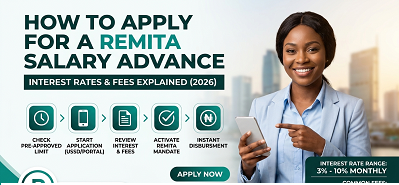
Step 1 is to log into the USSD application or Partner Portal.
Select the partner organization of your choice (e.g., Access Bank QuickBucks, WageX, or Page Financials). Use your phone number connected to your Bank Verification Number (BVN) to access their secure online portal or dial the appropriate USSD shortcode.
Step 2: Confirm Your Identity & Verify Pre-Approved Limits.
Enter your profile information and BVN. Your maximum acceptable loan amount, which is often limited to 50% to 200% of your net monthly earnings, is displayed on the Remita backend, which quickly communicates your past salary inflows with the lender.
Step 3: Examine interest rates and verify the direct debit mandate.
Read the conditions, upfront deductions, and monthly interest charges carefully. For the platform to automatically take the payback from your subsequent salary, you must click to accept the Electronic Remita Mandate form.
Step 4 is instant fund disbursement.
The transaction is automatically executed after confirmation. In less than ten minutes, money is transferred straight into your allocated salary account after being promptly routed via the central financial rails.
FAQs
If I don’t have an Access Bank account, can I still apply for a Remita salary advance?
Indeed. Although Access Bank is the main infrastructure provider, third-party clients from any Nigerian commercial bank can obtain immediate advances through the Remita payment network as long as their company uses Remita to process monthly salaries.
What may make me ineligible for a loan?
If you have an outstanding loan with another financial institution, if the phone number you provided on your application does not match your BVN records, or if your employer has not yet sent the paycheck information for the previous month, your application may be rejected.
What happens if, on the day of the planned repayment, my account is not funded?
The active Remita Direct Debit Mandate will keep sweeping your primary salary account until the debt is paid off if there aren’t enough funds on payday. Lenders have the legal power of set-off under Nigeria’s Global Standing Instruction (GSI) regulatory standards, which means the system can access and deduct the outstanding sum from any other bank account in Nigeria that is connected to your unique BVN. A lower credit bureau score is another consequence of delinquency.